For an 18-year-old in Hyderabad, an attempt at serving tea in eco-friendly ways turned out to be a means to get a college education. And all thanks to thirty-seven-year-old mechanical engineer Satyanarayana of Hyderabadm who launched “Taste Buds”, a chain of tea stalls on December 11, 2015, across Hyderabad. Instead of using plastic or paper cups, he serves his customers in earthen cups shaped like glasses.
Sir Ganga Ram (1851-1927) was a civil engineer and leading philanthropist of his times, who established the Renala Hydral Power Station in Renala Khurd in 1925.
Sir Ganga Ram, the great son of Punjab, was born in 1851 in Mangtanwala, a small town about 64 km from Lahore. From the beginning, he proved to be a brilliant student and in 1869, he joined the Government College in Lahore on a scholarship. In 1871, he obtained a scholarship to the Thompson Engineering College at Roorkee, India. He graduated in 1873 and was awarded with a gold medal.
I lost my parents very early on and came to Bombay at the age of 6 with a relative. I began begging at signals since that age and eventually became a ragpicker. I've had a tough time on the streets, where I couldn't defend myself on many occasions and had no food for days -- Bombay isn't friendly to us street rats. A few years later, when I was rag picking, a man came upto me and asked me if I wanted to work at a chai stall-- and I immediately agreed! I began selling tea, and making my own money after working for almost 12 hours a day.
Hemant Patel has personally witnessed what hunger can do to people — not once but twice. That's why he understand the need to do something.
“I know what hunger is,” says Hemant, with deep sorrow. He remembers the time when his daughter fell ill and was admitted to VS Government Hospital, Ahmedabad. She asked Hemant to get her some food from outside because she could not stomach the hospital food.
Pakistani-born astrophysicist Dr Nergis Mavalvala was among the team of eagled-eyed scientists who, for the first time, observed ripples in the fabric of spacetime called gravitational waves.
“I often think about a girl I met while installing bulbs,” she told the Glamour magazine. “She longed to go to school, but her parents couldn’t afford it. Once they started saving on their energy bill, they could. She is why I do this. It’s her life I want to change.”
Three simple words that best personify Neerja Bhanot.
Three simple words that explain why this young and vibrant girl earned world-wide acclaim for her courage and gallant actions.
Three simple words that show how at the tender age of 23 and just 2 days before her birthday, Neerja laid down her life, while saving hundreds of others.
“Physics itself is exciting enough. It’s not like a 9-to-5 thing. When you’re tired you sleep, and when you’re not, you do physics.” – Sabrina Pasterski
Mansukhbhai had a traditional business of pottery making, but he wasn’t interested in it, because the business was declining. His mind diverted to rooftop tile manufacturing. Being a potter himself an idea hit his mind one day when he thought, if tiles could be made out of clay, then why not other products?
Kochi's well-known pediatrician Dr PC Alexander took four street kids to a restaurant, Saravana Bhawan on Janpath, New Delhi, to buy them a hearty meal.
A highly distinguished pediatrician Dr Alexander works as a Senior Consultant Aster Medcity at Kochi.
The kids had stopped Dr Alexander in front of Saravana Bhawan for money. Instead of coins he marched inside along with them and gave them a sumptuous treat.
n. (Especially in former times) a person who makes a living by travelling from place to place mending pans and other metal utensils. The tinkers live by mending pots and pans, telling fortunes and selling horses and ponies at the various fairs throughout the country.
Or
The Free Dictionary says that a tinkerer is “one who enjoys experimenting with and repairing machine parts.”
Speaking is a right. When the voice box of patients is removed during surgery, they crave to speak. As if the trauma of the disease is not enough, the shock of having lost their voice takes a toll on them, emotionally. The prosthesis available in the market costs Rs 20,000 (to be changed once in six months) and is not viable for many poor patients.
Leonard Willoughby said, “As you begin to live according to your own guidance and your own daring everything changes completely.”
Life was not always perfect this man. His father died when he was 7 years old. All that his father left behind was a run down barber shop. With her husband no more, Ramesh Babu's mother had to work as a cook to help feed her children and give them a decent living.
Since she couldn't run the barber shop, she rented it out for Rs 5 a day. Ramesh recalls that their family survived on one meal a day.
Encouraged by her mother, Ramesh decided to earn a diploma course in electronics. His father's shop was still being rented out for meagre amounts. He then decided to run it himself and in 1989, he began working at the salon .
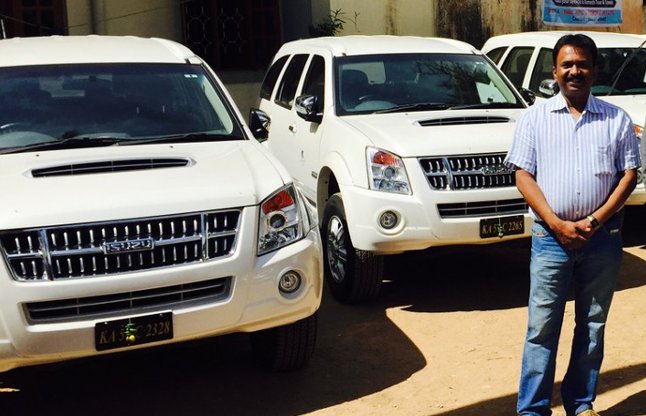
In 1994 Ramesh decided to buy a Maruti Omni for personal use. But since the car was most of the time idle, he decided to lease the car. One of his mother’s employers advised him to lease the Omni to Intel, the company she worked with.
“It all began from there and, by 2004, I had six cars all engaged in the same business,” Babu says.
Eventually, the car rental drew in customers from the travel and tourism industry. With the help of a bank, he bought seven more cars between 1994 and 2004 and his company was now known as Ramesh Tours and Travels. In 2004, Ramesh decided to penetrate the luxury car segment and bought a Mercedez Benz for Rs 4.2 million. After that purchase, his car rental literally mushroomed. As they say, the rest is history. Ramesh now own a fleet of 154 luxury cars - Toyota, Volkswagen, Mercedes Benz, BMW and a Rolly Royce. With a crew of 60 drivers, he rents out his cars for as low as Rs 1,000 a day to Rs 50,000 a day.
Today, his fleet consists of around 200 cars, including imported vehicles like Rolls-Royce Silver Ghost, Mercedes C, E and S class and BMW 5, 6 and 7 series.
Despite of this success, Ramesh still cut hair in the barber shop from 8 am to 10 am. From 10 am to 4 pm, he works at his car rental office. At 4 pm, he goes back to his saloon and works there till 7 pm Thereafter, he comes back to the rental agency and stays there till 8.30 pm.
He is as happy to receive the payment from his customers in the barber shop the way he did when he first worked as a barber. Ramesh charges male customers for Rs 65 a haircut and ladies’ are charged Rs 150. There are five more people working with him.
He says “This is my way to remind myself of my humble beginnings.”
Ramesh Babu still keeps his Maruti Omni but he does not rent it out anymore, the car now a lasting monument to his success, showing that one good choice coupled with hard work can lead to success.
“Somehow, things have clicked for me,” says Babu, whose clients include politicians, police officers and film stars such as Salman Khan, Aamir Khan and Aishwarya Rai Bachchan. With a film on his life — expected to be released in three languages — in the pipeline, his Bollywood contacts may come in handy.
Ramesh, who speaks Telugu and Kannada at home, says, “There’s a phrase in Telugu which basically means that don’t forget your past, even if you reach the highest milestone in life. I truly believe in that.”
Ramesh, a +2 dropout, who later finished a diploma in Electronics from Industrial Training Institute, has been a lucky man. Be it from his children, who are always in awe of their dad, or the elders in his family, Ramesh has always found encouragement.
Ramesh Babu reiterated the simple message to entrepreneurs that he told students to follow in his TED talk.
A computer that operates using the unique physics of moving water droplets has been developed by an Indian-origin scientist and his team.
The computer is nearly a decade in the making, incubated from an idea that struck Manu Prakash, an assistant professor of bioengineering at Stanford University, when he was a graduate student.
Manu Prakash, who amazed the world last year by building a paper microscope, has now come up with a computer that works by moving water droplets. Prakash is an assistant professor of bioengineering at Stanford University and he has developed the water computer with the help of two of his students. He was born in Meerut, India.
When Stanford University bioengineer Manu Prakash traveled to a mosquito-infested rainforest in Thailand a couple of years ago, he visited a clinic with a sophisticated, $100,000 microscope that sat unused in a locked room. It was then Prakash realized that what global health workers really need is an ultra-low cost, simple-to-use, portable microscope that could be deployed in the field to diagnose disease—and he took it upon himself to develop one!
The result is the Foldscope, a ‘use and throwaway’ microscope that Prakash demonstrated last week at the first-ever Maker Faire at the White House.
Clockwise from upper left, Foldscope projecting a magnified image onto a table; a diagram of an assembled Foldscope; magnified images of disease-causing microbes as seen through a Foldscope.
Here’s what you need to know about the Foldscope. It’s made out of thick, waterproof paper and a glass-and-polymer lens that’s the size of a large grain of sand. While it can be used by simply holding the device up to the sun or a light bulb, there’s also a version illuminated by tiny LEDs powered by an inexpensive watch battery.
The framework of the Foldscope is printed onto a sheet of paper that’s perforated in a way that each shape can be easily snapped out and folded in a manner resembling the traditional Japanese art of origami. A diagram showing how to assemble the Foldscope is even included on the sheet, and can be understood by anyone, regardless of their native language.
Different designs, folding patterns, and types and numbers of lenses create different types of microscopes: bright field, dark field, fluorescence, and lens-array. A low-magnification microscope costs as little as 50 cents, while a high-mag version is just shy of a dollar.
So, how do you use the Foldscope? It turns out that this bookmark-size device uses the same glass slides that one uses in a regular microscope. So, the preparation of blood or tissue samples remain the same. In the simplest version of the scope, the slide is inserted between the microscope’s paper layers and the user, with a thumb and forefinger grasping either end of the microscope strip, holds the lens close to one eye and flexes the strip to find the target object and bring it into focus. I had the chance to try this at the White House event, and found that learning how to use it is very easy. In more advanced versions, the device can project the image onto a wall or any other flat surface—a great, low-cost tool for educating healthcare workers and others in low-income nations about various infectious diseases.
Prakash is currently fine-tuning Foldscopes so they can be field tested in Ghana, Uganda, Nigeria, and Peru for diagnosis of malaria, microfilariasis, leishmaniasis, schistosomiasis, and sleeping sickness. His team at Stanford is also busy designing Foldscopes to help diagnose 30 other diseases, and drawing up plans for a next generation of Foldscopes that will utilize microfluidic components rather than glass slides—a step that should make sample collection and analysis even easier.
Not only will Foldscope give healthcare workers around the globe better ways to detect, and thereby treat, disease, it will also place magnifying power within the reach of all the world’s students, enabling them to ask and answer a great many scientific questions. To this end, Prakash has launched the Ten Thousand Microscopes Project to entice inquiring minds to beta test these devices and design experiments that can then be compiled into a crowd-sourced microscopy text. Imagine a world in which every kid carries around a 50-cent portable microscope, and brings science out of the lab and into real-world biology.
Already 10,000 citizen scientists from 130 countries have answered the call. Among the ideas: a proposal from a Mongolian farmer who wants to use Foldscope to detect potential pathogens in camel milk. Think about it – what would you do if you had one of these in your pocket?
Manu Prakash
Manu Prakash received a B.Tech from IIT, Kanpur and a PhD. in Physics of Computation and Physical Biology from MIT. He was nominated a Junior Fellow in Physics at Harvard Society of Fellows. Manu is a Pew Scholar, a two-time Gates Foundation Explorations Award Winner, Terman Fellow, MIT Tech review TR35, Popular science “Brilliant 10″ and a TED Senior Fellow. Manu is a member of Stanford Biophysics Program, Woods Institute of the Environment and a core faculty in Department of Bioengineering at Stanford.
He has been involved in technological interventions in resource-poor settings, tackling public health problems. The lab has recently invented a new tool tackling a major diagnostics bottleneck in global health: Foldscope, a microscope built via folding paper. It currently costs 50 cents to manufacture at scale with a goal to provide a “microscope for every child” in the world.
Blindness may be the biggest curse. In folklore, it is said: "If you lose your teeth, you will lose taste; if you lose your eyes, you will lose the whole world!"
What about people who are born blind? Destiny definitely seems to be cruel in their case. However, there are a few who don't sit idly, complaining how they got served injustice - they simply pick themselves up and make a point of becoming an inspiration to others too.
Asif Patel, a mechanic from Pakistan, is one such example. Suffering from a rare disease, he was born without eyes. But even as a child, he had a great sense of touch. Now, as they say, his touch is his magic. He repairs automobiles with his sense of touch only. His customers are a happy lot.
He is renowned in the area of Karachi, owing a small workshop that also employs seven people.
Used in more than 10 billion devices throughout the world, the USB turned 20 years old last week. However, the man who discovered the technology has not made a single penny off it and he is fine with it.
Ajay Bhatt, Intel’s Chief Systems Technologist, who’s largely responsible for inventing the USB technology, told Business Insider, “I don’t do these things for money. I did this to bring about change, and it’s not very often that somebody gets a chance to bring about this big a change.”